Through the "Magnet. Alliances for Educational Success" program, the Institute supports the educational center in a pedagogical transformation process that uses the scientific method and the exploration of the marine ecosystem as the core pillars of learning.
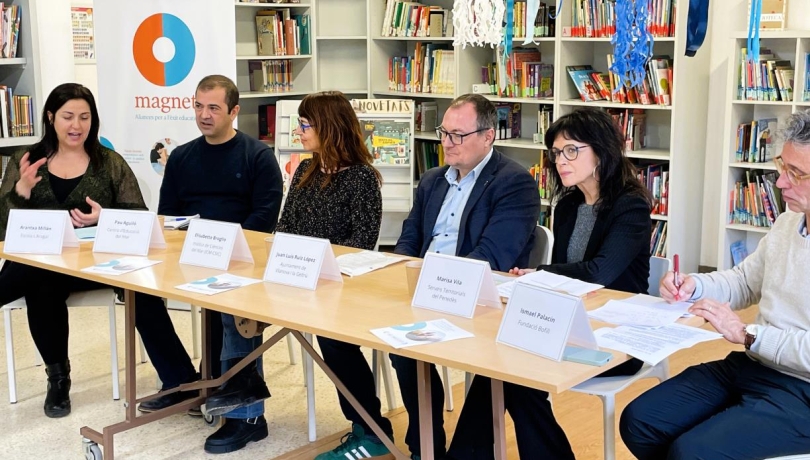
The Institute of Marine Sciences (ICM-CSIC) has reaffirmed its commitment to education and scientific outreach by presenting a new strategic alliance within the Magnet program. On this occasion, the ICM-CSIC is joining forces with the L'Aragai School in Vilanova i la Geltrú and the Marine Studies Center (CEM) in Sitges to deploy an innovative educational project that places marine research at the center of the school curriculum.
The alliance, officially presented on February 5th, seeks to foster the personal growth of students through critical thinking and scientific rigor. For the ICM-CSIC, this collaboration is not just a communication action, but a profound commitment to social transformation. As highlighted by Elisabetta Broglio, Deputy Vice-Director of Scientific Culture at the ICM-CSIC:
"Commitment to society is a fundamental pillar of our institution; for over 20 years, we have put great effort into communicating, disseminating, and involving citizens in the science we do. We are very happy to participate for the third time in Magnet Alliances, an inclusive, educational, and long-term program equipped with the best professionals, allowing the scientific and educational communities to work in depth for a real transformation of everyone involved."
The scientific method as an educational tool
The essence of this project, under the slogan "A sea of learning, an ocean of opportunities. Let's share adventures!", is to allow children to investigate the marine environment and the coastline through a globalized approach. The ICM-CSIC contributes its human capital—composed of more than 200 oceanography specialists—to bring knowledge of physics, chemistry, geology, and marine biology directly into the classrooms.
The methodology focuses on inquiry and critical thinking. It is not just about learning concepts, but about applying the scientific method to understand and explain the world. As Broglio states, Magnet projects require continuity, ensuring that knowledge takes root meaningfully within the school.
Furthermore, within the framework of this alliance, L'Aragai School may join the network of Blue Schools, consolidating its interest in the marine environment and its conservation. This link will allow students to address current challenges such as the presence of plastics in the sea, invasive species, or fisheries management, encouraging boys and girls to ask questions and awakening potential scientific vocations.
Connection with the territory and environmental awareness
One of the ICM-CSIC's key objectives in this collaboration is to reinforce the students' sense of belonging to their immediate environment. Vilanova i la Geltrú is a city closely linked to the blue economy, and the educational project aims for students to experience the sea with both appreciation and scientific rigor.
Carine Simon, educational project coordinator at the ICM-CSIC, underscores the enthusiasm with which they approach this challenge:
"We approach this project with excitement, facing the challenge of having the school reach out to the sea, feel a connection with it, and feel a sense of belonging toward this part of the territory, working from a place of appreciation and scientific rigor in a cross-disciplinary way. This year, moreover, the collaboration with the CEM will be key in this task."
In this regard, the Marine Studies Center (CEM) will contribute its expertise in environmental education through biodiversity workshops and field trips to the port, complementing the ICM-CSIC's cutting-edge research with practical on-site experiences.
The Magnet program is an initiative promoted by the Bofill Foundation, the Department of Education and Vocational Training, and the Institute of Educational Sciences at the UAB. With over 12 years of history, it has proven to be a successful tool for opening educational centers to institutions of scientific excellence, positioning innovation as a driver for educational improvement. For the ICM-CSIC, being part of this network is an opportunity to continue building a more critical, empathetic society committed to the future of our oceans.