This is the main conclusion of a new study by the Institut de Ciències del Mar (ICM-CSIC), which reveals that ocean productivity and the abundance of competitors are key to understanding competition among large pelagic predators.
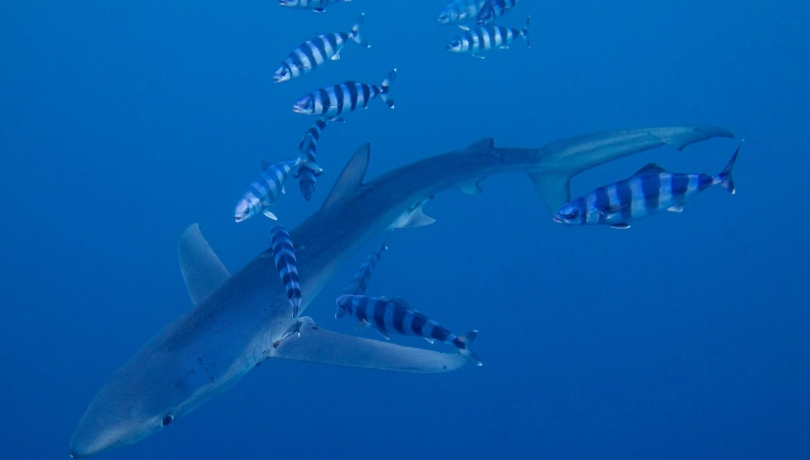
Large ocean predators such as swordfish, blue sharks or makos not only compete with each other for food, but are also capable of adjusting their feeding habits depending on the food available and the presence of other competitors. This is demonstrated by a new study led by the Institut de Ciències del Mar (ICM-CSIC) in collaboration with the Spanish Institute of Oceanography (IEO-CSIC) in Málaga, recently published in Proceedings of the Royal Society B.
According to the study, pelagic productivity — that is, the amount of food available in the water column — and the abundance of competitors in the environment are two factors that influence how these species partition resources in order to coexist.
“In the open ocean, where resources fluctuate and direct observation is difficult, understanding how competition is organised among predators that coexist in the same place is essential to predict the effects of climate change and overfishing,” explains Elena Fernández-Corredor, a PhD researcher at ICM-CSIC and lead author of the study.
She adds that the study’s results show that competition within the same species (intraspecific) is influenced mainly by ocean productivity, while resource segregation among different species (interspecific competition) is more affected by the abundance of competitors.
To carry out the research, the team analysed samples from three of the main predators in the northeastern Atlantic and the Mediterranean: swordfish (Xiphias gladius), blue shark (Prionace glauca) and shortfin mako (Isurus oxyrinchus). Drawing on more than 450 samples collected between 2017 and 2019 by IEO observers onboard the Spanish longline fleet, the researchers combined stable isotope analyses of carbon and nitrogen — which reveal the animals’ diet over several months — with spatial models of abundance, productivity and fishing activity.
“The onboard observer programme, which has monitored catches and fishing activity in real time for decades, has been essential to characterise the relationships between these large predators, their prey and the surrounding environment,” notes Salvador García-Barcelona, researcher at the Málaga Oceanographic Centre and co-author of the study.
Regarding the key findings, the results show that swordfish experience the highest level of competition among individuals of their own species, while blue sharks and makos share more than 80% of their trophic niche, indicating that they consume similar prey.
“In highly productive areas, species tend to feed on the same resources because there is enough food for everyone; however, when resources decrease, each species becomes more specialised and expands its trophic range, seeking different prey to avoid direct competition,” explains Joan Navarro, researcher at ICM-CSIC and co-author of the study.
According to Francisco Ramírez, researcher at ICM-CSIC and co-author of the study, these mechanisms have critical implications for conservation:
“In more degraded ecosystems, such as the Mediterranean, declining resources can intensify competition and alter the balance between species,” warns . “This could favour more opportunistic predators, such as swordfish, and displace sharks, which are already in decline.”
Changes in ocean productivity caused by climate change or fishing pressure could therefore modify trophic relationships among large predators, severely affecting the stability of marine ecosystems.
“If food becomes scarcer, less flexible species may not adapt in time. Understanding these mechanisms helps us anticipate which predators will be most vulnerable and design conservation strategies that consider not only individual species but also their interactions,” concludes Marta Coll, researcher at ICM-CSIC.
The research is part of the COTI project, funded by the Biodiversity Foundation of the Ministry for Ecological Transition and the Demographic Challenge through the Pleamar Programme, and co-funded by the European Union through the EMFAF (European Maritime, Fisheries and Aquaculture Fund), as well as the European projects FutureMares and Ges4SEAS, both under the European Union’s Horizon 2020 programme.